For the past year, I’ve been bouncing back and forth like the world’s biggest indecisive fool between macOS, Windows, and Linux.
One week I convince myself that I should just accept Windows for what it is. Maybe it’s not so bad after all. For a while. Then come the little stabs in the side. The things that make it impossible to ever be completely satisfied. One update later, and suddenly my workstation sounds like a wind turbine.
Why?
Because Microsoft ”optimized” something.
Or after finally getting my local AI environment working flawlessly, Windows Defender suddenly decides that my own self-written scripts are no longer allowed to run because they’re considered an unsafe file format.
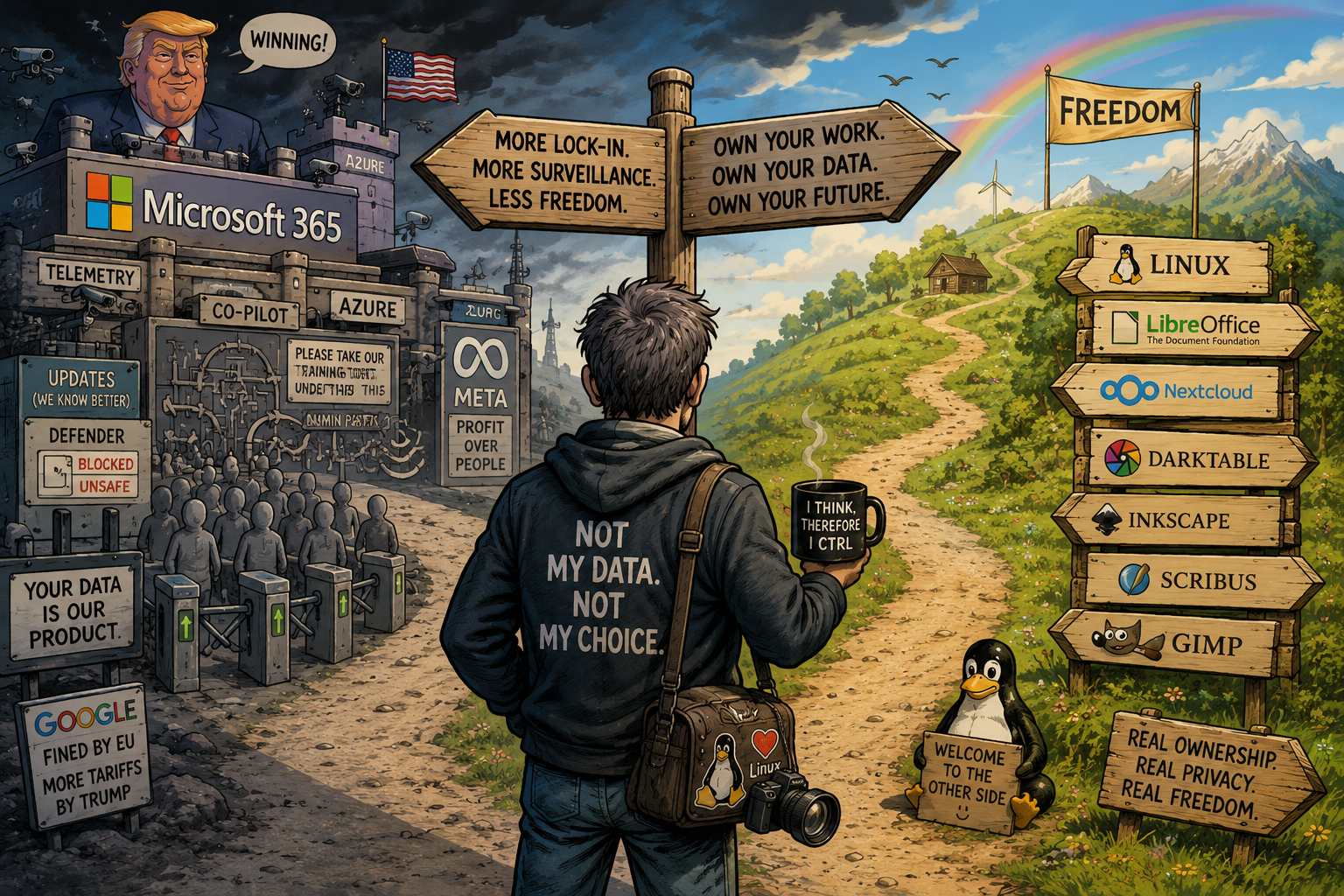
I’ve even gone all in on Microsoft 365. I wanted to see whether everything would finally click if I simply embraced the whole ecosystem. Leave telemetry enabled. Let Windows, Outlook and the rest of Microsoft’s services work together exactly as they intended. Sadly, it doesn’t get any better. You constantly run into small annoyances that somehow manage to ruin an entire workday.
I even connected my own domain to Microsoft Business so I could access the full Azure environment. Surely that would make everything better? Not really. Yes, Microsoft collects less personal data in their business products, and Copilot isn’t used in quite the same way as the consumer services. But at the same time, you’ve surrounded your own computer with so many policies, restrictions and security layers that it barely feels like your computer anymore.
The single worst piece of software I’ve ever encountered is Microsoft’s administration portal. The place where you manage users, licenses and subscriptions. I honestly don’t think I’ve ever seen an interface designed so incredibly badly. It’s so confusing that Microsoft themselves recommend taking training courses just to understand how to use it.
Seriously?
Then there’s the bigger picture. The companies behind nearly all of the software and cloud services we depend on are based in the United States. And what has been happening on the other side of the Atlantic during the last few years has made me increasingly uncomfortable. Most of these corporations seem perfectly willing to bend the knee to the Trump administration if it protects their profits.
Cowards.
Donald Trump is the most dangerous—and arguably the most ignorant—major politician the modern world has seen. He has an extraordinary ability to damage almost everything he touches. Watching this unfold has also exposed how distorted parts of American society have become, where keeping people poorly educated often appears to serve those who benefit from misinformation.
Meanwhile, Europe has begun pushing back. The European Union has repeatedly taken legal action against companies like Google and Meta for violating privacy, competition and consumer protection laws. If you want access to the European market, you have to play by European rules. When Google ignores those rules, it becomes expensive.
Trump’s response has been more tariffs against European goods—taxes that are initially paid by American consumers, something many of his supporters still fail to understand, while ultimately hurting European exporters as well.
Then we have Meta. Time after time, they find themselves facing lawsuits, investigations and criticism over copyright infringement, fraudulent advertising, privacy violations and identity theft. At the same time, more and more countries are beginning to realize that social media—in its current form—is not healthy. Governments around the world are introducing age restrictions and tighter regulations aimed at platforms such as Meta and TikTok because they have repeatedly failed to regulate themselves.
Profit comes first. Ethics barely enter the conversation. Because of all this, I’ve reached a conclusion.
I no longer want to build my professional life on American, profit-driven ecosystems.
People often tell me; ”I have no choice. My job depends on it.”
I understand that argument.
I simply don’t believe it is good enough anymore.
At some point, we have to draw a line.
We have to say: ”This isn’t acceptable.”
For me, that means that—regardless of the challenges ahead—I will be working on Linux.
Microsoft Office will be replaced by LibreOffice. Calendars, contacts and cloud storage will move to my own Nextcloud server, complemented by Telia Cloud, which is built on Norway’s Jottacloud infrastructure. Unfortunately, this also means saying goodbye to software I genuinely admire.
DxO PhotoLab.
Nik Collection.
Affinity.
The irony is that these aren’t even American products. They’re French and Australian. But without Linux versions, they simply no longer fit into my workflow. Instead, I’ll be relying on Darktable, Scribus, Inkscape and—unfortunately—GIMP.
The learning curve will be steep.
It will be frustrating.
But I believe it’s the right thing to do.
People in the Linux community have been saying for decades, ”This is the Year of Linux.” I think they’ve often been looking at the wrong problem. The operating system isn’t the issue.
The software ecosystem is. The day professional software developers realize that creative professionals genuinely want an alternative to the American tech ecosystem, Linux will finally have its breakthrough.
Until then, users like us can still make a difference.
Not by waiting.
By choosing.
As for me…
I’m taking my own path.



0 Kommentarer