
A follow-up to ”Getting it right from the beginning” (2013)
Thirteen Years On, the Argument Remains
Thirteen years ago, I wrote about retouching. About how it was never a modern invention, never a digital sin, never something that began with Photoshop or ended with the press of a button. The argument was simple, and it held: retouching is as old as the human urge to tell a story. The cavemen knew it. The painters of Versailles knew it. Abraham Lincoln’s photographer knew it.
The argument still holds. What has changed is the world around it.
In the years since that article was written, the camera in your pocket has become more powerful than the studio equipment of a decade ago. Artificial intelligence now makes decisions that photographers once agonised over for hours in a darkroom or at a desk. Algorithms determine which images reach a billion eyes and which disappear without a trace. And the line between a photograph and a generated image has become, for many, entirely invisible.
Yet the story remains the same. Because it was never about the tools. It was always about the story.
The Most Honest Retouch Is the One Made Before the Shutter Opens
Consider what happens in the fraction of a second before you press the button. You choose where to stand. You choose your focal length. You choose your depth of field, deciding which parts of the world deserve to exist in the frame and which do not. You choose the moment. You choose the direction.
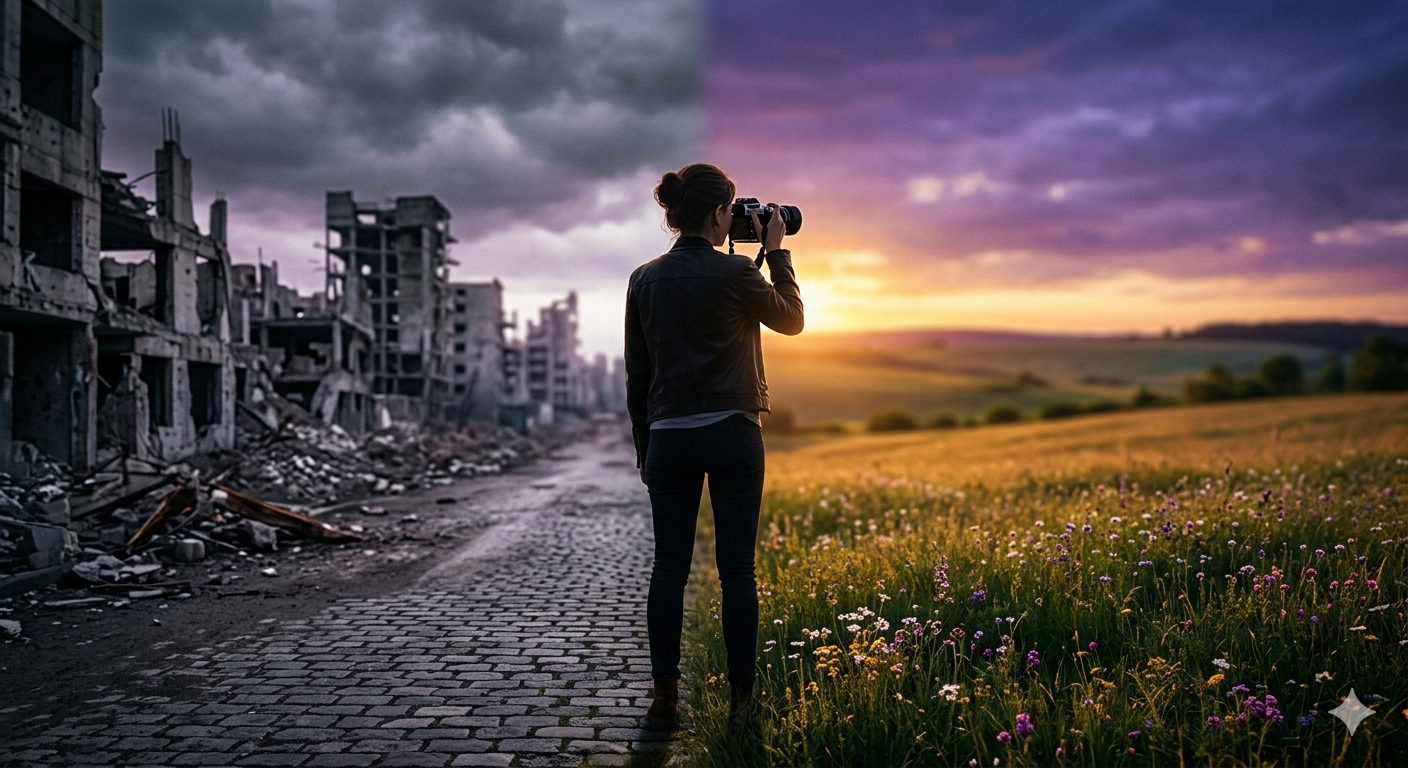
That last one is perhaps the most honest illustration of what photography has always been. Imagine standing somewhere in Ukraine. Behind you, a meadow in late summer light, wildflowers, a sky burning violet and gold at the horizon. In front of you, the remains of a building that was someone’s home three weeks ago. Both of these things are true. Both exist at the same coordinates on the same afternoon. You choose which way to point your camera, and in doing so, you write the story. No software required. No artificial intelligence involved. Just a human being and a decision.
That decision is retouching. It always was.
Two Men, One Truth, Entirely Different Methods
Henri Cartier-Bresson waited. That was his method. He understood that the world continuously arranges and rearranges itself into moments of geometric perfection, and that his job was simply to be present when it did. The man leaping over the puddle. The bicycle wheel and the staircase. The decisive moment. He did not manipulate the scene, but he most certainly manipulated the result — through patience, positioning, and an almost ruthless selectivity about what he allowed to become a photograph.
Robert Capa went the other direction entirely. He threw himself into the chaos and trusted that truth would emerge from proximity. And it did. His photographs from the beaches of Normandy, blurred and frantic and barely holding together, told a story that a perfectly composed image never could have. The imperfection was the story.
Both men were retouching. Both men were making choices that shaped what the viewer would feel, think, and remember. The tools were different. The intention was identical.
Artificial Intelligence and the Fear of the Obvious
We are now told, with some regularity, that artificial intelligence is changing photography forever. And in a technical sense, this is true. Modern cameras perform computational photography in real time, merging multiple exposures, sharpening eyes, smoothing skin, adjusting light before the image is even written to the memory card. Adobe Firefly can remove a stranger from your background with a single click. Midjourney can produce an image of a place that has never existed, lit by a sun that has never risen, inhabited by a person who has never lived — and it will be beautiful, and it will feel true.
This frightens some people. It should not.
What it should do is clarify something that was always the case. The image was never the reality. The image was always the story someone chose to tell about reality. The tools have simply made that more visible, more democratic, and considerably harder to ignore.
The question that matters has not changed. Is the story honest? Is it true to the intention of the person who made it? Does it make you feel something real, even if the thing it depicts is not?
A portrait retouched to reveal the character of the subject rather than merely the surface of their skin is honest. A news photograph manipulated to suggest an event that did not happen is a lie. The difference is not in the software. It is in the intention and the context of publication. A piece of art has no obligation to the facts. A news image has every obligation to them.
What Moves Us Has Never Required an Explanation
When I look at a photograph that moves me, I do not ask how it was made. I ask what it makes me feel, and whether that feeling is true. Ansel Adams spent days in his darkroom coaxing from his negatives the landscapes that existed in his imagination. Were they dishonest? Or were they simply finished?
When a fashion photographer works for two days with a lighting team, a stylist, a makeup artist, and then three more days in post-production, is the resulting image a lie? Or is it the fullest possible expression of a vision that began the moment someone looked at a blank page and imagined something beautiful?
Photography does not stop with the press of a button. It never did. The button is simply the moment you borrow light and shadow from the world and begin the work of turning them into something that means something.
The Story Was Always the Point
The tools will keep changing. The cameras will become smarter, the software more powerful, the line between captured and created more difficult to draw. None of that changes the fundamental truth that was true in the caves of Altamira, in the court of Louis XIV, in the darkrooms of the twentieth century, and at the desk where this sentence was written.
The story is what matters. The feeling it produces in the person who encounters it. The humanity it carries from the one who made it to the one who receives it.
Everything else is just method.
This article is a follow-up to ”Retouching – A Part of Photography,” published in 2013. [https://jonashellsen.se/blog/getting-it-right-from-the-beginning/]

0 Kommentarer